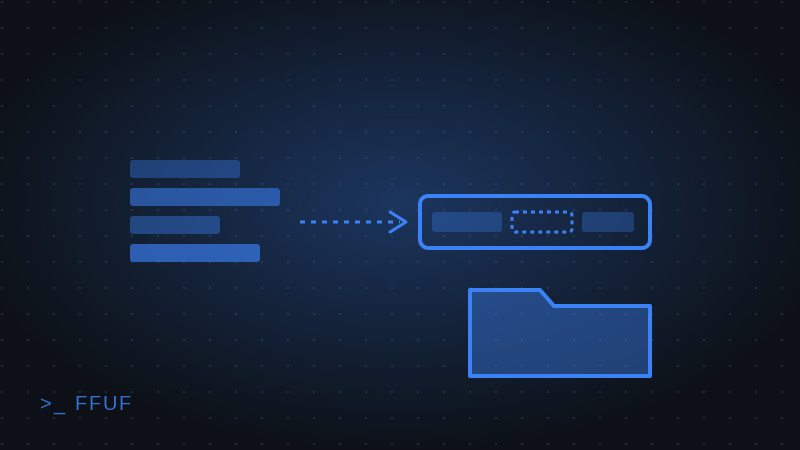
Web challenges often hide the interesting page: an /admin panel, a backup.zip, a .git folder. Nothing links to it, so you have to guess — fast. ffuf ("Fuzz Faster U Fool") replaces the word FUZZ in a request with each line of a wordlist and reports which ones get an interesting response.
Finding hidden directories and files
ffuf -u http://target/FUZZ -w /usr/share/wordlists/dirb/common.txtEach word replaces FUZZ and ffuf prints every hit with its status code, size and word count. A good starting wordlist is common.txt from dirb or raft-medium-directories.txt from SecLists.
Adding extensions
ffuf -u http://target/FUZZ -w common.txt -e .php,.txt,.bak,.zip-e tries each word with every extension as well. Backup and source files (index.php.bak, config.txt) are classic CTF finds.
Filtering out noise
Many sites return 200 OK with the same "not found" page for every path. Filter those out by size or word count once you see the repeated value:
ffuf -u http://target/FUZZ -w common.txt -fs 1534     # hide responses of 1534 bytes
ffuf -u http://target/FUZZ -w common.txt -mc 200,301,403 # only show these codes-fs, -fw and -fc filter by size, words and status code; -mc matches only the codes you list. A 403 is worth noting — the path exists, you just can't read it yet.
Fuzzing parameters and values
ffuf -u "http://target/page.php?FUZZ=1" -w burp-parameter-names.txt -fs 0
ffuf -u http://target/login -X POST -d "user=admin&pass=FUZZ" \
     -H "Content-Type: application/x-www-form-urlencoded" -w passwords.txt -fc 401
FUZZ can go anywhere: a parameter name, a value, a POST body or a header. That makes ffuf useful for finding debug parameters, IDs and weak passwords too.
Virtual hosts
ffuf -u http://target/ -H "Host: FUZZ.target.ctf" -w subdomains.txt -fs 4242When one IP serves several sites, changing the Host header reveals hidden ones like dev.target.ctf.
Be polite
ffuf is fast — only point it at targets you're allowed to test, and check the CTF's rules, since some events ban automated scanning against shared infrastructure. Use -rate to limit requests per second. For hand-crafted payloads against a single request, Burp Suite's Intruder is the GUI alternative.